Swing-Boom vs. Fixed-Boom Machines
Comparing cost, stability & flexibility so you can choose the right mini excavator for your fleet
A contractor’s fleet is one of its most important assets. Ideally, each project the company takes on has a machine suited to the task. According to a recent McKinsey & Company report, demand for compact equipment has swelled over the last few years, with their versatility named as a driving factor.
Compact equipment can tackle projects in jobsites requiring more agility and less noise, and mini excavators are a popular choice. While these machines are hailed for their adaptability, there are still key aspects to consider before investing in any piece of equipment. Construction Business Owner reached out to Caterpillar’s Greg Worley to learn more about swing-boom and fixed-boom excavators. Read on for his expert guidance.
What’s the difference between a fixed boom and a swing boom?
A swing boom will let you let you right angles to the tracks. So, in tight spaces, you have more flexibility. The swing boom also allows the offset of the house to the swing boom, allowing parallel digging to the tracks whilst up against a structure. If you are working in a space between two fixed structures, you can dig a square trench, the width of the machine, without repositioning. This is not possible with a fixed-boom machine.
Both fixed- and swing-boom machines can lift similar weights. The fixed boom is more stable, due to the boom foot being in the center of the machine and not out the front, connected to the boom swing cast. If a swing boom is not required, fixed-boom units can be very cost-effective whilst providing similar performance.
When is a fixed-boom excavator the best option?
When handling heavy loads close to the machine body. They can also turn 180 degrees in a tighter radius.
Is there generally a cost difference between the 2 machines?
Yes, the swing-boom machine requires more components and increases the weight, so they tend to have a higher cost over the fixed-boom units.
What is maintenance like for each type of machine?
Very similar, but the fixed boom has fewer moving parts, so fewer grease points.
Should attachments play a role in a contractor’s choice?
If customers are using heavy attachments such as tilt rotators, grapples and mulchers, the fixed boom may be a better option due to stability.
Is there anything else our readers should know?
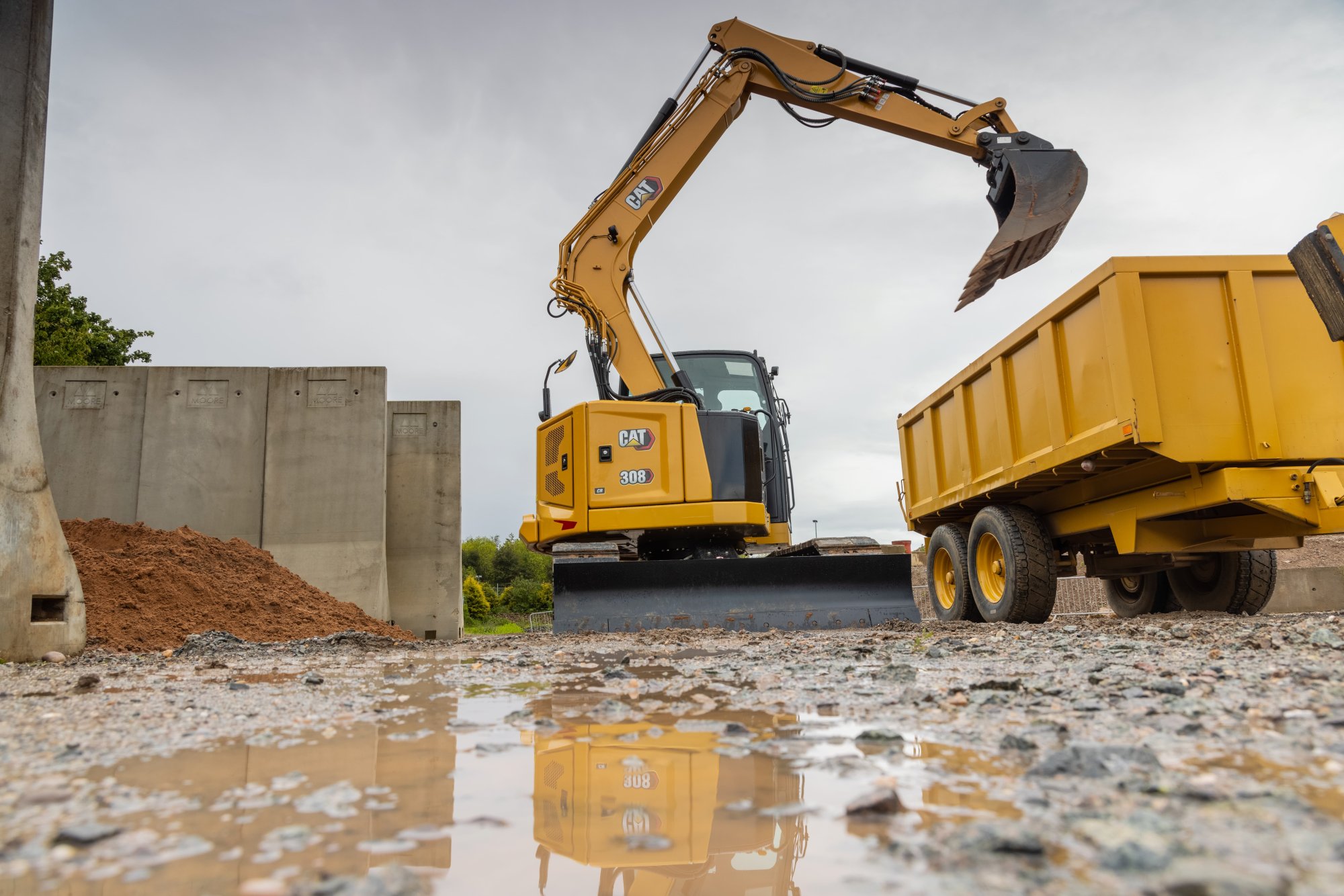
If customers are using hydromechanical attachments, make sure the hydraulic capability is the same as the fixed- and swing-boom models, like on Cat’s 308 CR (FB) and 308 CR (SB).
OUR DIGITAL PARTNERS