The Future of Small Fleets
Using IoT to build interconnected jobsites
Today’s jobsites are more complex than ever. Crews are stretched, equipment moves constantly and managers face mounting pressure to do more with fewer resources. Traditional telematics solutions, with their one-way data transmissions and time-consuming manual processes, cannot keep pace with these challenges.
In parallel, jobsites have long operated on a simple premise: Workers use machines to complete tasks. For example, a mobile elevating work platform (MEWP) positions workers at height, and a telehandler lifts and moves materials across construction sites. But technology is fundamentally changing how productivity is understood, shifting jobsites from collections of isolated equipment into dynamic, interconnected systems.
From Manual Operations to Intelligent Fleet Management
For years, telematics systems have been designed for basic tracking. Data flows one way, requiring users to request information and then manually interpret it. Processes like geofencing require multiple steps to set up and reassign machines. Locating equipment on crowded or multistory sites often requires significant time to search. Routine maintenance, such as updating machine software, takes more than two hours per machine. In today’s labor-constrained environment, these inefficiencies quickly add up, delaying projects and increasing costs.
At the same time, the traditional process of working at height involves multiple steps outside a worker’s core expertise. Operators must identify the appropriate machine, navigate it to the work area, precisely position the platform and return safely to ground. While essential to safety, these steps represent time spent managing equipment rather than completing skilled work. Balancing safety procedures and efficiency has long been a challenge.
IoT as the Foundation of Smart Fleets
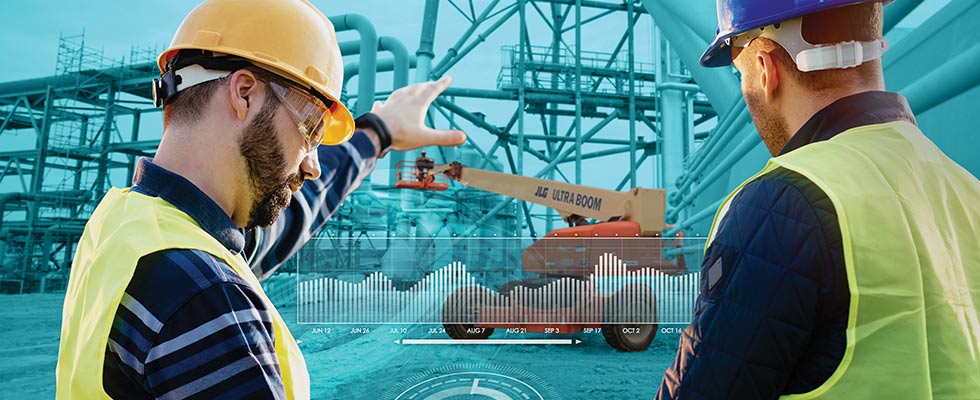
The Internet of Things (IoT) transforms fleet management by taking telematics far beyond simple data collection. Built in-house from the ground up, modern IoT systems integrate hardware, software and mobile connectivity into a single ecosystem, delivering two-way communication that allows users not only to receive information from machines but also to interact directly with them in real time.
For example, these systems are collecting insights from multiple operating parameters — including utilization, ignition cycles, battery state-of-charge and diagnostic trouble codes — and then making the most important, need-to-know information immediately available through customizable dashboards and mobile tools.
This shift supports a broader transformation underway on jobsites. Rather than viewing machines as isolated assets, industry leaders are embracing ecosystem orchestration — a holistic vision where equipment communicates, coordinates and optimizes performance. Dynamic monitoring, autonomous positioning and intelligent data sharing represent a new approach to work that enhances safety, improves efficiency and unlocks new levels of operational performance.
Automation That Simplifies Daily Operations
With thousands of connected machines already in the field, smart fleet management platforms can continue to expand their capabilities, adding new layers of automation, insight and control. Innovations such as automated site networks, digital access control, over-the-air machine software updates and elevation-based localization simplify complex tasks and bring true automation to everyday fleet operations.
For example, automated site networks remove the need for manual geofence setup by allowing machines to automatically create or join networks as they are delivered, moved or shipped. Site networks dynamically update in real time, enabling managers to filter machines by jobsite, identify assets needing attention and eliminate guesswork around equipment location.
Digital access control transforms traditional keypads and physical keys into a secure digital experience. Machine operation can be restricted, limited or fully enabled through mobile tools, helping owners and managers control who operates equipment, when and where. This evolution transitions users from simply connecting machines to connecting entire jobsites.
Updating machine software has traditionally been one of the most time-consuming tasks in fleet management. Technicians had to connect laptops, record settings and manually reprogram parameters — a process that could take over two hours per machine. Over-the-air machine software updates digitize this workflow, reducing update times to less than 30 minutes per machine while automatically restoring settings from memory. The result is faster compliance, scalable efficiency and skilled labor freed for higher-value tasks.
On complex, multilevel projects, traditional GPS data often falls short. Elevation-based localization uses barometric pressure sensors to identify not only where equipment is on-site but also whether it is above or below the user’s position. Inventory management is streamlined, service calls are simplified and crews spend more time working instead of searching.
Ecosystem Orchestration & Equipment Symbiosis
The jobsite of the future will be interconnected, built on seamless coordination between digital ecosystems, automated workflows and intelligent equipment. Ecosystem orchestration ensures that contractors, suppliers and stakeholders are aligned and working toward common goals, while equipment symbiosis allows machines to communicate, share resources and adapt in real time. Together, these principles create responsive, data-driven environments that optimize efficiency, enhance collaboration and improve sustainability.
By integrating real-time communication, optimized resource management and automated workflows, construction sites become more efficient and better equipped to manage risk, minimize delays and reduce waste. Connectivity enables predictive maintenance, remote monitoring and actionable data that improves equipment utilization and operational decision-making.
Connectivity, Productivity & Safety
Productivity and safety remain top priorities on every jobsite. With connected solutions, fleet utilization is maximized, idle time minimized and operational efficiency driven to new heights. Advanced monitoring, sensors, telematics and automation reduce human error in repetitive tasks and ensure equipment is in the right place at the right time. These technologies support jobsite awareness and help identify potential risks before they become issues.
The biggest opportunity lies in digitizing jobsite operations and turning raw data into actionable insights. However, integrating disparate systems and scaling connected solutions while keeping them intuitive remains a challenge. Balancing advanced capability with simplicity is essential for widespread adoption across jobsites of all sizes.
Looking Ahead: Interconnected & Autonomous Jobsites
The future of construction lies in harmonizing automation, electrification, connectivity and robotics. Interconnected jobsites will support autonomous capabilities, smart materials, automated maintenance and seamless workflows. Purpose-built, route-based autonomous vehicles and intelligent systems are ideal for construction environments with repetitive tasks and predictable routes.
The transformation underway is not about replacing human workers but empowering them. By reducing manual intervention, minimizing risk exposure and creating intelligent work environments, smart fleets enable more strategic deployment of people and resources.
Automation is no longer a luxury; it is a necessity for modern fleet management and long-term competitiveness.
OUR DIGITAL PARTNERS