How Strategic Technology Investment Pays Off
Managing large-scale residential construction with precision while recruiting the next generation of workers
The Dallas-Fort Worth metroplex is home to over 7.5 million people, and its rapid growth is leading to large-scale residential developments.
Building a 300-lot high-end residential development with custom ditch lines required millimeter-level precision, but for Mount Pleasant, Texas-based Stephenson Dirt Contracting, it was “just another day at the office.” After all, the company operates a diverse range of machinery across multiple areas, handling work from multiphase commercial projects to oil field maintenance.
The company, established in 1987, has been harnessing the latest technology for decades, evolving from a small firm into a highly regarded, experienced sitework contractor. Approaching this project in the fast-growing Texas prairies and lakes region simply required the next iteration of technology.
While technology makes handling large-scale residential construction projects easier, its real benefit may be its role in attracting the next generation of workers. Younger workers are digital natives, and by making the construction industry digital-first, the industry can help address the long-standing worker shortage that has plagued it.
Training the next generation of workers to use the latest technology not only maximizes productivity on the immediate Texas project but also helps the Stephenson Dirt team overcome structural workforce challenges by developing talent rather than relying on recruitment.
A Company With a Deep History
Change and evolution are part of the Stephenson Dirt story. The company began using high-precision surveying equipment early, helping to gain a foothold in supporting the oil industry.
Today, as in its earliest days, the company views technology as a strategic response to an ever-changing landscape, largely centered on the talent shortage.
“We soon realized that capturing information using this equipment was really valuable for setting out, and then we set up systems on the graders and upped our productivity an insane amount,” said John Kent Stephenson, general superintendent.
“This was because we weren’t having to have a guy out there manually checking levels, so the graders could just fly through those locations and punch them out,” Stephenson added. “We then started investing in more technology and diversifying the business into more commercial and residential construction projects like this.”
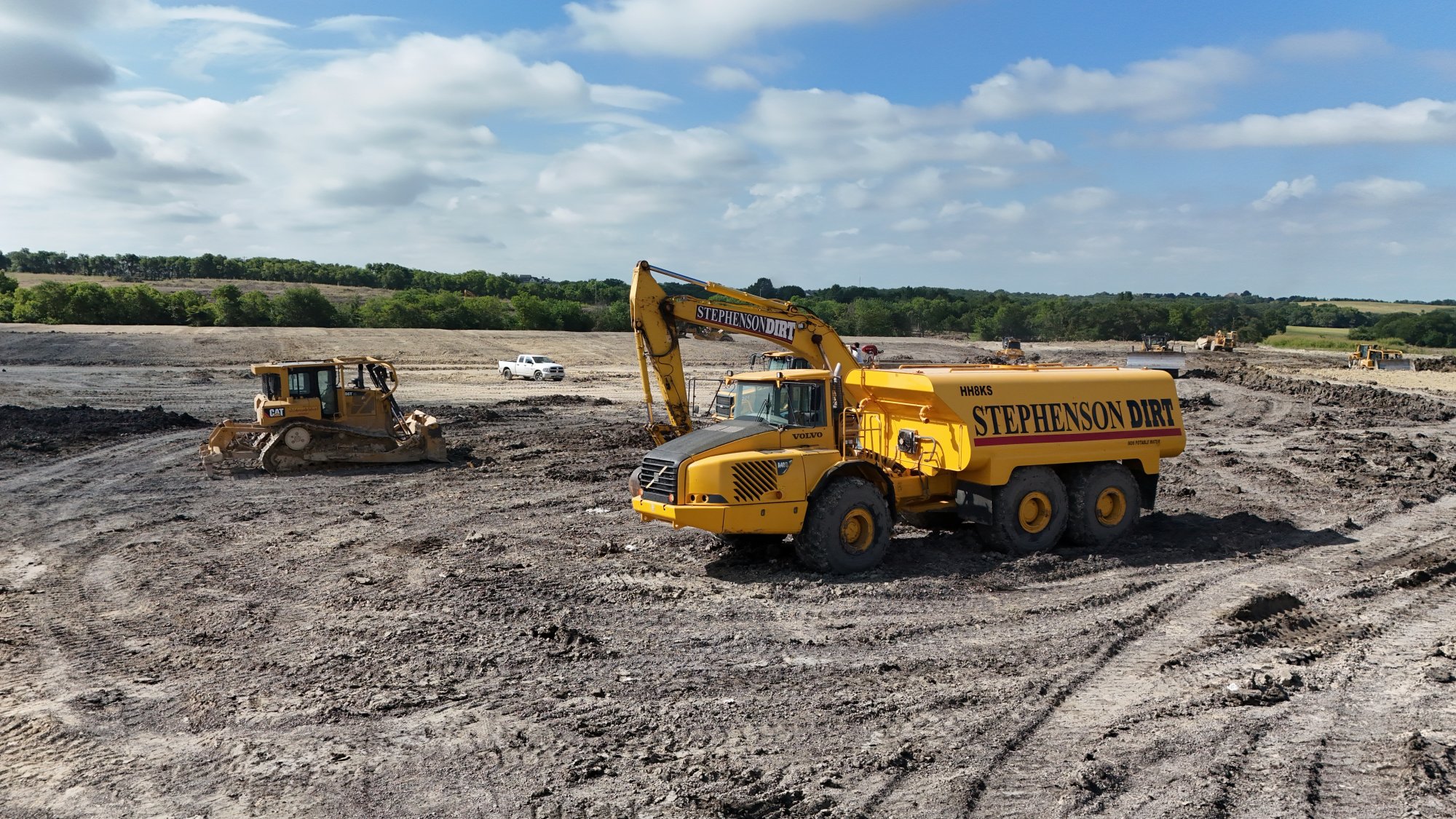
The company now operates several crews across the region, equipped with over 80 earthmoving machines. At least 60% of them are fitted with machine control, which a local dealer, Four Point Solutions in New Braunfels, provided.
“Having used other systems before, the service we get from them smokes what we had in the past,” Stephenson said. “If we have a problem, they just jump on it, and the next day or even hours later, we are back up and running. They also supported our rollout of the Leica ConX system, which allows us to send all our models using the mobile network to our machines across any jobsite.”
For the Dallas-Fort Worth residential development project, Stephenson Dirt required accurate grading and ditch shaping across hundreds of plots. It also needed to manage changes in dirt volume due to water saturation.
The only way to accomplish this was to ensure real-time communication and coordination across teams and with clients. That would require training new operators efficiently in GPS and machine control workflows.
“This is a typical job for us, taking a virgin plot and reshaping it for housing,” Stephenson said.
As part of the core excavation and material movement phase, the team performed 6-foot moisture conditioning to create a site that spans more than 150,000 square meters.
The Solution
To successfully approach the project, the Stephenson Dirt team used a range of equipment for the core earthworks part of the project, including three Caterpillar motor scrapers, three Cat D6T dozers and a Cat D4. In preparation for the plot shaping, they also turned to a Komatsu PC360LC. And with the need to water down the earth, the team tapped into a local water main, setting up a pump system to fill two Volvo A40D trucks.
To ensure the project is graded according to specification and to eliminate the prospect of expensive rework, the team fitted the Cat D6T dozers, the excavator and the lead Cat 621B paddle scraper with Leica Geosystems’ 3D machine control from Four Point Solutions. But adding machine control technology to dozers and an excavator was just one aspect of the technology deployment.
“Recently, we have also paired drone surveying with our earthworks models, which again helps to visualize the project,” Stephenson said. “This has been huge as we can let our clients know if we are growing dirt or losing dirt in real-time.
“This is a real issue in Texas as we have to water down the sites to effectively move and place the dirt, and this process swells the dirt,” Stephenson added. “So, it grows, and we still need to move it and monitor it over time to also see what we lose.”
Changes immediately affect a project’s costs, timeline and production. By keeping the client updated, the company can collaborate with its client, maintain productivity and inform them of any changes in real time, thereby mitigating potential surprises upon completion.
By doing so, the Stephenson Dirt team has gained a competitive advantage by perfecting its digital workflow with support from its local dealer team.
“When you are looking at incorporating 3D machine control on any size of site, but particularly large projects like this, you need to start with robust survey control; without it, you don’t have anything,” said Phillip Gillen, a dealer manager with Leica Geosystems.
“This is where Stephenson Dirt has worked hard to perfect its end-to-end process,” Gillen continued. “From survey control, it’s all about the data prep and working up the project design files. These often come in a CAD format, highlighting the deliverables that are needed for the project.”
The team then converts these into earthworks models for the specific machine types.
“In the case of this project, it would be excavators, motor scrapers and dozers,” Gillen said. “With accuracy particularly important across the site, the team in this case is using a localized base station that the machines are measured against for horizontal and vertical tolerances.
“So, with everything linked together, when the operators show up for work, the first thing they do is check to see if there are any model updates, which are sent through the cloud,” Gillen added. “These are then downloaded, and they can go to work safe in the knowledge they are putting the right dirt in the right place.”
The Results
One only needs to look at the way Stephenson Dirt has adapted its business to use different methods and adopt a 3D approach to project delivery to see how the industry is evolving.
Retrofitting machine control on older equipment, such as Cat scrapers, can increase the equipment’s value by improving productivity.
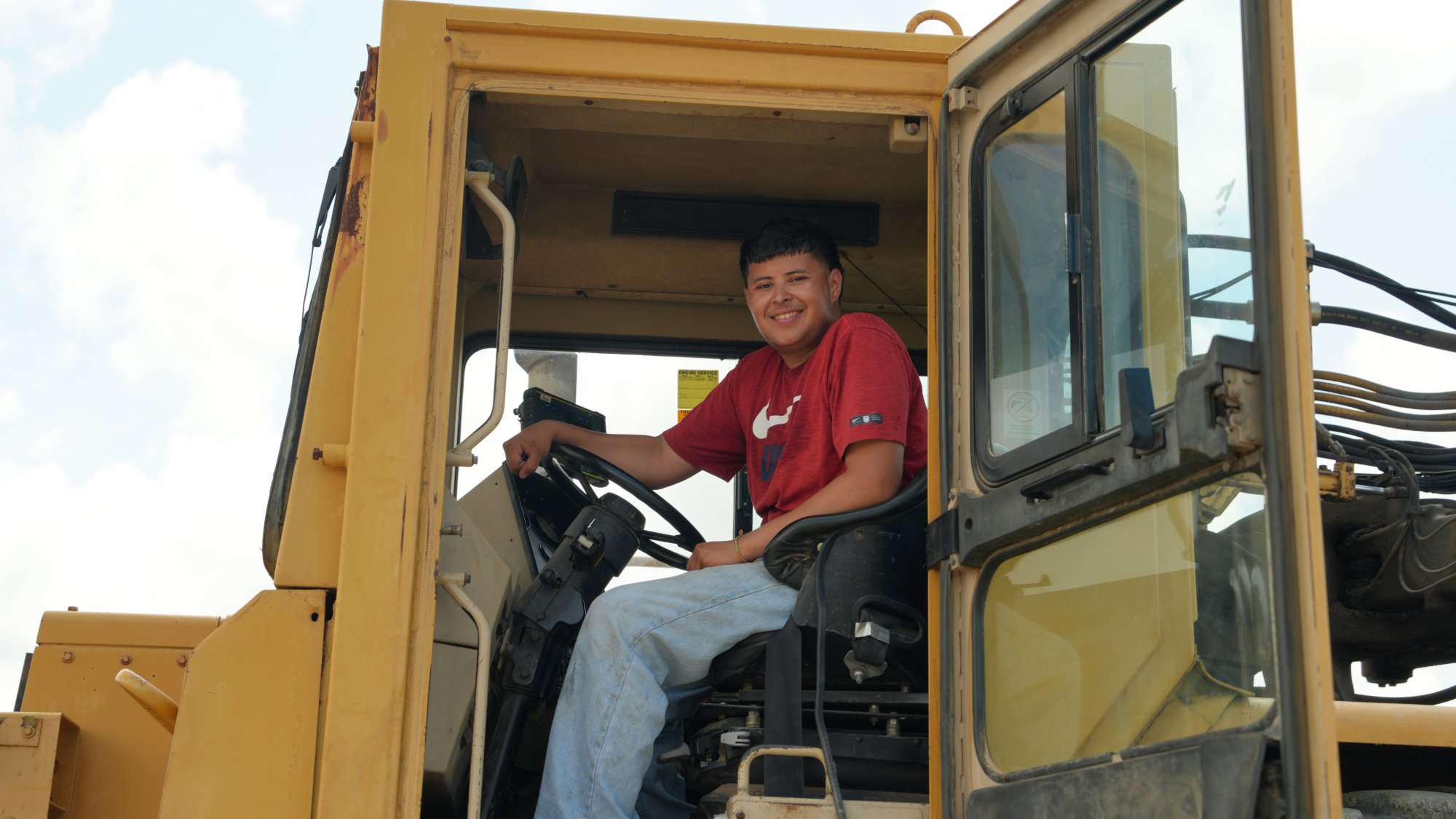
As an added benefit, the team is developing the next generation of talent, like 21-year-old Oscar Miranda, who has already operated a range of machines, including excavators, backhoe loaders and skid steers. Given that many contractors struggle to hire, the Stephenson Dirt team knows that a mix of technology and mentorship can turn recruits into highly effective, productive team members.
Despite his young age, he operates a Caterpillar 632F paddle wheel motor scraper. The first machine Miranda operated was a skid steer while working on various tasks on one of Stephenson Dirt’s residential projects.
The best way for Miranda to begin in the industry is to gain a broader understanding and operating experience in various roles and machines.
“The skid steer was a lot of fun to drive, and I learned a lot about how to handle it in different tasks from shifting dirt to moving other materials around and generally keeping the yard clear,” Miranda said. “It was definitely the best machine to start on, as I had to quickly learn how to operate the joysticks and change attachments.”
Once he had mastered the skid steer, Miranda went on to operate a backhoe loader.
“With the backhoe again being a utility machine, I found myself doing even more tasks like learning how to dig trenches,” Miranda said. “This then helped me to progress into working on excavators. But I always had my eye on the bigger machines, so I pushed myself hard to get an opportunity to work on a dozer.”
While the industry grapples with a long-standing labor shortage, companies that embrace technology and a digital-first mindset gain a competitive advantage.
OUR DIGITAL PARTNERS