





The workforce shortages contractors face today are significant and expected to persist for years. As firms try to overcome the challenges of fewer workers, other factors are expected to further shrink the availability of qualified labor and increase the number of jobs in the construction industry.
Successfully navigating the current landscape of low labor supply and high project demand requires a business strategy focused on more than recruiting workers. Digitally assisted project planning for ceiling and wall installations is a solution that can support contractors — and their businesses — on multiple levels. This includes allowing jobs to be completed on time and on budget, despite fewer workers.
In addition, it can help ensure contractors maintain, and possibly build, their businesses by bidding on more construction projects and tapping into the movement toward more complex ceiling designs.
To follow, we’ll look at the environment construction businesses are operating in today, as well as the ways digitally assisted support services can help drive success in overcoming challenges and leveraging opportunities.
Half-Million-Worker Shortage & Other Bottom-Line Challenges
Estimates from Associated Builders and Contractors indicated 439,000 new construction workers were needed in 2025 to meet rising demand in the construction industry. While contractors struggle to have adequate crews on-site, factors are at work to decrease the pool of available tradespeople. Among these are federal policies aiming to restrict immigration, a rise in the number of workers who are 55 and older, lack of trade interest among the younger generation and a shortage in training resources. As labor shortages continue, contractors can also expect to face a growing number of project opportunities driven by anticipated lower interest rates inspiring more new construction, post-pandemic office renovations, and a surge in the building of data centers and manufacturing facilities.
Multiple “trickle-down” effects of the labor shortage stand to impact a firm’s bottom line:
- Wages are on the rise and eating into profits. According to the Bureau of Labor Statistics, between May 2021 and May 2022, average hourly wages for production and nonsupervisory employees in construction rose 6.3%.
- Contractors are competing for workers, which can drive up the cost of incentivizing new hires through better wages, benefits and more.
- Unsure if they can handle certain jobs, contractors are forgoing job opportunities. The U.S. Chamber of Commerce reported that in 2021, more than one-third of contractors turned down projects.
- According to Associated General Contractors of America, 54% of contractors experienced project delays due to labor shortages in 2024, which can also add costs and prevent a company from moving on to the next job.
- Contractors may be outbidding themselves to account for increased labor-related costs and delays.
Improved Bidding Accuracy, Increased On-the-Job Efficiency & More Project Opportunities
By using emerging digital support services that offer complete design-to-installation support, contracting businesses can overcome labor challenges as well as take advantage of shifts in the number and complexity of renovation and new construction projects. Be sure to look for a partner offering digital services that offer complete support — from takeoff to project closure — and include human oversight on everything from design evaluation to ways to enhance the digital technology. Below are several advantages digitally assisted support services offer in ceiling and wall installations.
Digitalization of the takeoff process supports faster, more confident bidding.
Digital services are revolutionizing the way contractors bid a project. For instance, ceiling solutions can be digitalized and, when applied to a reflected ceiling plan (RCP) layout, automate the exact quantities of every component needed for that project. This capability greatly increases the accuracy of materials needed on the jobsite. Ultimately, digitalization takes the guesswork out of estimating, provides a total materials package in which the contractor can be fully confident and significantly expedites the bidding process.
Digital support services simplify & accelerate project installation by providing 1 convenient & complete drawing package to guide contractors.
Digital technology can evaluate a project scope while considering the installation process. As a result, potential issues — such as perimeter hardware clashing — can be vetted before any materials reach the jobsite. Drawing packages should include a bill of materials, accurate and comprehensive finish schedules for all components across the project, clear layouts, and highly detailed drawings and schematics that enable seamless installation.
Digitalization supports fewer wasted hours.
The best digital service will take the lead and collaborate with architects in the design phase of a project to clearly understand the materials needed to execute the design intent. That digital service will then collaborate with the contractor to revise plans based on actual jobsite conditions, eliminating time that otherwise may have been wasted backtracking to fix mistakes. This level of collaboration and project efficiency will enable a project to be completed on schedule and on budget and allow contractors to move more quickly to their next job.
Digital technology can optimize materials within a project space based on realistic scrap reusability.
For example, digitalization can analyze every cut panel at the perimeter of a ceiling and determine if the cutaway scrap can be used in another perimeter location. This significantly reduces material, providing a huge cost savings for the contractor while helping to facilitate sustainable construction practices.
Digital support services give contractors the confidence to take on more complex designs.
As architects push the boundaries to meet expectations for greater individuality and ingenuity in their designs, contractors must install these complex visuals with impeccable precision. By enabling accurate and faster bids — as well as by ensuring installation is completed correctly the first time — digital support services offer contractors a critical competitive advantage, no matter how complex the project.
Digitally Assisted Planning Delivers 'Unparalleled' Results in Seattle Boardroom
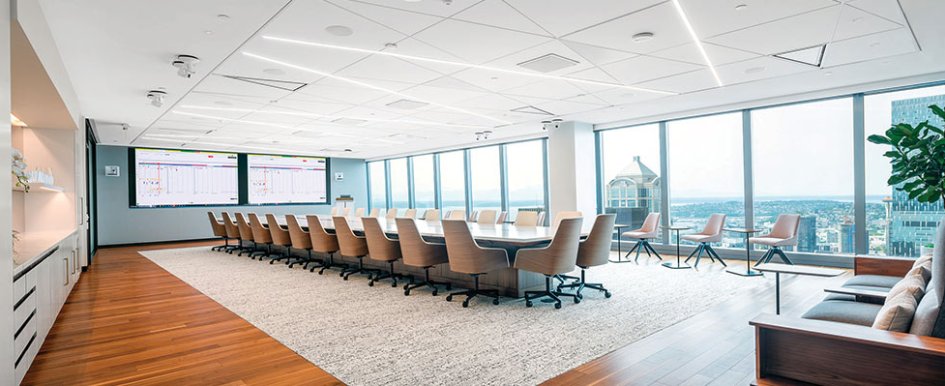
The Seattle-based technology company F5 Inc. had steep requirements — including a five-month start-to-finish timeline — for its boardroom renovation, a project that would create an optimized hybrid meeting environment. One of the most distinguishing elements of the 44-story F5 Tower is that the building is slanted and features angled glass curtain walls. While this gives it a sleek appearance, it creates significant challenges for interior wall and ceiling upgrades because the existing structure in which architects, designers and builders must work is not parallel. The challenges of the ceiling renovation for the 1,000-square-foot boardroom made the project ideal for the design flexibility, total integration and time-saving benefits of digitally assisted planning.
The team included NBBJ (architect), Acoustical Design Inc. (contractor) and Armstrong World Industries (provider of products and the digitally assisted design and preconstruction service). The boardroom utilized seven integrated ceiling solutions to create the desired diagonal movement, resulting in a wall-to-wall seamless ceiling design that upholds the integrity of the space as well as the F5 Tower.
The digitally assisted design and preconstruction service facilitated a continual flow of communications. The computer-aided design (CAD) specialist felt confident that, by the teams working together, the design could be installed after completing a few iterations, resulting in the project meeting the client’s goals and time frame. Because they understood the difficulty of the constructability of the desired angles, the design and preconstruction service team was also able to deliver on the designer’s vision.
Multiple versions of the original design were created to achieve the final look. Next, the digitally assisted project
planning provided a comprehensive RCP drawing package to support the project that included panel, grid and hub layouts. A full-line bill of materials was also provided to streamline bidding and ordering.
“We were able to preinstall all of the brackets on each of the four main runners,” said contractor Peter McClain of Acoustical Design Inc. “So, by the time we got to the jobsite, it was a simple click and go.”
By outlining recommendations that eased installation and reduced time, material and labor, digital assistance helped ensure things were completed right the first time — resulting in a ceiling that took only five months, from design to completion.
In the face of labor challenges, digitally assisted project planning should be considered an essential part of contractors’ business strategies to help prevent further strain on the workforce, timelines and budgets. These services should also be embraced for the ways they support material optimization, facilitate a smoother collaboration between architect and contractor, and open new opportunities to take on projects with highly complex designs.