The Margin Gap Hidden in Your Fleet
Finance & operations have the data; the problem is actual usage rarely connects to costing.
Ask most contractors how profitable their last equipment-heavy job was. Then ask how confident they are in that number.
The honest answer is usually some version of: “pretty sure.” Not certain.
That gap between what the job appeared to earn and what it actually cost once equipment is fully accounted for is one of the most persistent and underappreciated margin problems in construction. It doesn’t show up as a line item on any report. It compounds quietly across jobs, across years, and across the fleet. And by the time it becomes visible, it’s usually already done real damage.
Every Cost Has a Paper Trail. Except Equipment.
Think about what happens when you need to verify any other job cost. Labor: someone signed a timecard. Materials: there’s a delivery ticket matched to a purchase order. Subcontractors: an invoice ran through accounts payable. Even rented equipment came with a vendor agreement that codes itself to the job.
Owned equipment doesn’t work that way. Nothing generates an invoice. The machine doesn’t send you a bill. Its cost has to be constructed internally through rate assumptions, periodic allocations and operator-reported hours that nobody can fully verify.
For most contractors, that internal system is a rate table set a year or two ago, a spreadsheet maintained by one person, and a monthly reconciliation that’s part accounting and part educated guess.
That’s not a criticism — it’s an age-old problem that no one has a true solution for, and everyone approaches differently. Owned equipment cost is fragmented across systems that were never designed to talk to each other: depreciation in the ERP, maintenance history in the shop system, fuel in fleet card data, utilization… wherever the operator wrote it down.
The Data Already Exists. It’s Just in the Wrong Place.
Here’s what makes this problem solvable now when it wasn’t five years ago: the data needed to cost equipment accurately is already being captured. It’s just living in different systems than the financial ones.
By now, most contractors are using some form of telematics for visibility at a minimum over their fleet. Telematics systems already know when the machine was running and when it was idling. Geofencing already ties equipment to specific jobsites. The maintenance system already has every work order, every part, every hour of mechanic time. All of that is equipment cost data — it’s just never been connected to a job cost structure automatically.
What’s been missing is the layer that bridges field activity and financial reporting: a system that takes what the machine actually did, applies the right rate based on actual utilization, and posts it to the correct job and cost code without someone manually assembling it at month-end.
What It’s Actually Costing You
The consequences of the gap are bigger than most contractors realize, because they’re not just financial. They’re strategic.
At the project level, equipment-heavy jobs absorb less than their fair share of fleet cost when rates are flat, and utilization is estimated. Those jobs look more profitable than they are. Some become what you might call false winners — not because the crew was more efficient, but because the cost never fully landed on the job.
At the estimating level, the next bid gets built on historical data that was wrong. If the mass excavation job looked great on paper because equipment was under costed, the next similar job gets bid the same way, and the margin gap compounds.
At the team level, the cycle that plays out every month in most contractor organizations is familiar to anyone who’s been in it. The shop bills based on what the operator wrote down. The project team disputes the hours. Finance often is unable to truly, or confidently, reconcile the difference. The machine’s true cost to the job never fully makes it onto the books. Someone in the back office has to explain the variance.
Quick Diagnostic: Is the Gap Affecting Your Business?
If you answer “I’m not sure” to any of these, the gap is real:
- How much did your equipment actually cost your last three jobs, per machine?
- When were your internal rate assumptions last updated?
- Could you show exactly how your equipment costs were calculated?
- Which of your jobs over the past two years were truly profitable once full equipment costs are applied?
The Utilization Problem Most Contractors Don’t See
There’s one variable that has more impact on equipment cost accuracy than any other: utilization, and it’s the one most contractors handle the least precisely.
The core issue is that fixed ownership costs (i.e., depreciation, insurance, taxes, financing) accrue whether the machine is running or sitting on standby. They don’t stop when the excavator waits two weeks for a utility relocation. They don’t adjust when that same excavator logs only two productive hours on a surgical storm drain job, leaving the rate to recover ownership cost from work hours that never happened.
When a flat rate gets applied uniformly, machines running twelve hours a day and machines sitting on standby get charged the same. One project overpays. Another underpays. Neither number is right and both flow into your job cost history.
The fix isn’t complexity for its own sake. It’s visibility: a rate structure that reflects actual utilization rather than assuming it, so both the equipment team and the project team can see where the number comes from and act on it while the job is still in progress.
What Closing the Gap Looks Like
Contractors can close this gap by adding a layer that connects the operational data they already have to the financial workflows they already use.
In practice, that means equipment activity flowing automatically from the actual job based on what the machine actually did, with the correct cost code and the right rate applied. The result is job cost data that reflects reality: margins that are based on actual equipment consumption, billing records the shop and project team can both stand behind, and defensible financial reporting with confidence, that doesn’t require a month of reconciliation to produce.
It also changes what’s possible in real time. When equipment costs flow to jobs as activity occurs — rather than being allocated at period end from stale data — project managers can see cost implications while there’s still time to act.
New Technology Built for This Problem
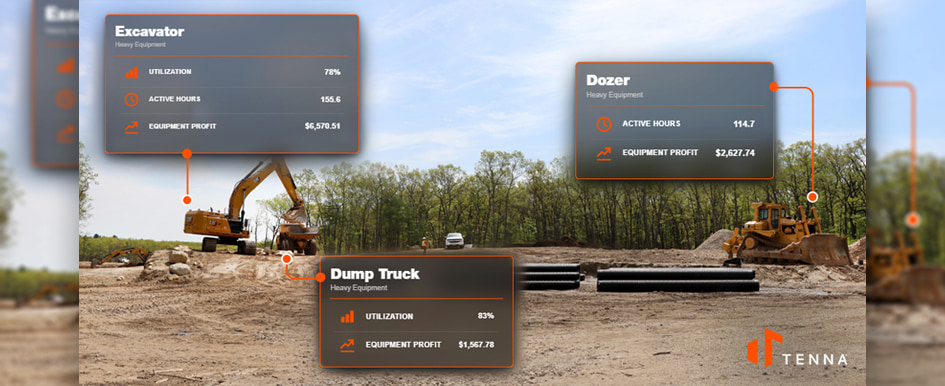
Tenna’s Asset Financials is the construction industry’s first telematics-powered equipment economics engine, purpose-built to close this gap.
It automates job costing and internal billing using live operational data. Equipment hours come from the machine, not a timecard. Job assignments are driven by geofence logic, not manual entry. Custom rates are built and applied consistently.
The platform is ERP-friendly, not ERP-replacing. It feeds accounting systems the operational context they’ve always needed to be accurate without requiring a rip-and-replace of current workflows. Contractors define their rates, how their rates apply, how values are interpreted and how billing logic works. The system supports the model already in place rather than imposing a new one.
The Contractors Who Get There First
Equipment will keep being one of the largest and most variable cost categories in construction. The question is whether it continues to be partially understood or becomes a fully integrated part of how you manage financial performance.
Closing the gap doesn’t require new systems or added headcount. It requires a connection between the operational data already being captured in the field and the financial workflows already being used in the back office.
The contractors who make that connection first will know which jobs are actually profitable, which assets are earning their keep, and where margin is being left on the table.
Learn more about Tenna’s Asset Financials.