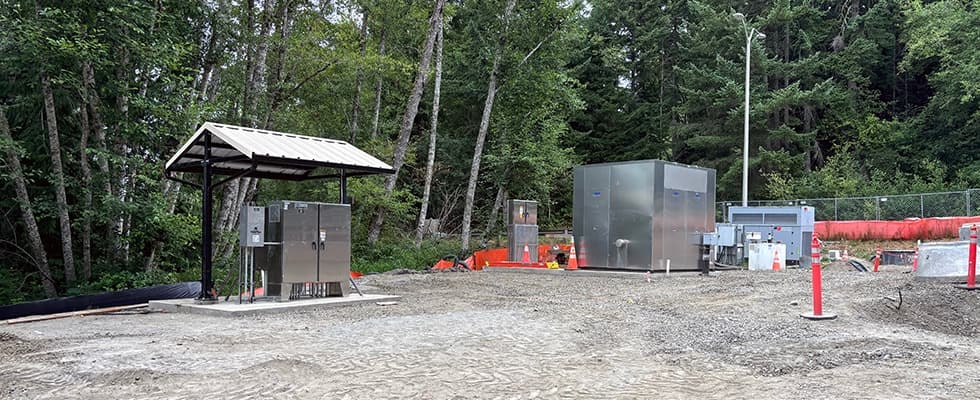
How a Navy lift station was saved
Decisive contractor leadership helped rescue a critical wastewater lift station project
By: Sanne Godfrey/Romtec Utilities
When a wastewater lift station project at a classified U.S. Naval base ran into serious trouble, the contractor was faced with a difficult decision: continue trying to make a failing system work or take action to protect the project, the owner, and the long-term performance of the station.
The original pump system provider had been removed from the job, leaving the contractor and owner with a stalled project and an uncertain path forward. Rather than allow the issue to continue delaying progress, the contractor worked with the U.S. Navy to evaluate the problem, pivot quickly, and find a solution that could move the project forward with confidence.
“The contractor deserves credit for recognizing the issue and taking the steps needed to protect the project,” Romtec Utilities President Ben Cooper said. “Our role was to support their effort with the engineering, equipment coordination, and system design needed to help them deliver a reliable solution for the owner.”
The Contractor’s Pivot Kept the Project Moving
The U.S. Navy needed a wastewater lift station that could meet the application’s performance requirements, fit within the established project footprint, and move through approvals without creating further delays. The contractor understood those expectations and worked to identify a solution that would satisfy the owner while limiting disruption to the work already completed.
Romtec Utilities supported that effort by redesigning the pumping system around a fiberglass wet well that could stay within the previously established footprint while preserving as much of the already approved equipment as possible, including key pump and enclosure components. Other elements, especially the controls system, were redesigned or modified to improve functionality, coordination, and overall reliability.
That approach helped the contractor move the revised pumping system through review as a standalone package and continue advancing the project instead of starting over.
Fully Integrated System Design
The project underscored a broader issue in wastewater infrastructure: operational problems are not always caused by the pumps themselves, but can stem from system design, coordination, or installation decisions.
In this case, the redesign focused on fitting the system to the project’s existing requirements and approvals rather than forcing major changes to the surrounding work.
The revised station used a prefabricated design built around approved Crane Pumps equipment and was intended to provide a more coordinated long-term solution than the system it replaced.
Supporting the Contractor When the Project Needed It Most
By the time Romtec Utilities formally joined the recovery effort, the contractor was managing an active construction problem with schedule pressure, inspection concerns, and owner expectations all converging at once.
The contractor’s decision to address the issue directly created the opportunity for a better outcome. Romtec Utilities reviewed the application requirements, the approvals already in place, and the gaps in the existing system before preparing a redesign intended to meet the project’s operating needs.
“The contractor had already done the hard work of recognizing that the project needed a different path,” said Romtec Utilities Project Manager Mike Williams. “Our team came in to help them move quickly, coordinate the redesign, and provide a complete solution that gave both the contractor and owner confidence moving forward.”
Building Around Proven Crane Pumps
One of the biggest advantages in the redesign was the ability to build around already approved Crane Pumps equipment. In many wastewater lift station projects, changing pumps late in the process can trigger new submittals, extra review time, and added risk. Because the pumping equipment had already been approved, Romtec Utilities could focus on engineering the rest of the station around those pumps instead of starting the approval process from the beginning.
Crane Pumps are commonly used in wastewater applications that require handling solids-laden flows and maintaining operation under demanding conditions. In this project, the already approved pumps became the foundation for the redesigned lift station.
By incorporating the pumps into the redesign, Romtec Utilities was able to preserve prior approvals while improving the full wastewater lift station package. That approach helped the team:
- Maintain compliance with previously approved equipment.
- Eliminate unnecessary procurement and approval delays
- Provide reliable solids handling performance for demanding wastewater conditions
- Deliver a dependable long-term pumping solution.
The pumps were arranged in a triplex configuration to provide both operating capacity and redundancy. In a wastewater lift station, redundancy is essential because peak flows, maintenance needs, and unexpected operating conditions all have to be considered. A triplex arrangement gives the system more flexibility and supports dependable service when the owner needs it most.
Delivering a Complete, Integrated Wastewater Lift Station
The redesigned lift station included structural, mechanical, electrical, and communications components intended to function as one coordinated system. For the contractor, that meant fewer separate vendor responsibilities to reconcile during installation and a clearer path to delivering the project successfully.
Structural
- Large-diameter fiberglass wet well for corrosion resistance and durability
- Oversized precast top slab engineered for site requirements
- Fiberglass enclosure protecting above-grade equipment
Mechanical
- Triplex system utilizing Crane Pumps
- Prefabricated valve assembly with integrated piping and flow measurement
- Optimized layout designed to fit within the existing footprint
Electrical & Controls
- Programmable control system with operator interface
- Primary and backup level sensing for reliability
- Variable speed drives for efficient pump operation
- Stainless steel outdoor-rated control panel
Communications
- System designed for integration into the owner’s monitoring network
- Coordination with SCADA integrator for communication setup.
The coordinated design helped the contractor reduce field conflicts during construction while giving the owner a system planned around long-term operation and maintenance.
Why Prefabrication Supported the Contractor’s Recovery Plan
Because the project had already experienced setbacks, schedule recovery became a priority for the contractor. To support that goal, major system components were manufactured, assembled, and checked before shipment so they could be installed more efficiently in the field.
This approach delivered clear benefits:
- Higher build quality through controlled fabrication
- Faster installation timelines
- Reduced coordination challenges in the field
In practical terms, that meant less field assembly, fewer installation issues, and a faster path toward startup.
Prefabrication can also affect long-term performance. When piping layouts, controls integration, and equipment placement are resolved before delivery, installation tends to be more orderly, and future maintenance can be simpler.
A Strong Outcome Led by the Contractor
Despite the early setbacks, the contractor helped move the project forward by making a timely decision, coordinating with the owner, and bringing in the right technical support. The revised lift station aligned with previously approved equipment, supported the approval process, and provided a complete package intended to meet the project’s performance requirements.
For owners and contractors, that kind of outcome matters beyond a single job. Wastewater lift stations are critical pieces of infrastructure, and recovering a troubled project requires leadership, flexibility, and a willingness to make the right call when field conditions change.
In this case, the contractor’s ability to pivot helped turn a stalled lift station into a coordinated solution that could serve the owner for the long term.
The project offers an example of how contractors can use collaboration, technical support, and decisive action to recover infrastructure work when an initial system does not perform as expected.
For agencies and contractors managing complex wastewater projects, the outcome is a reminder that the right partner can help a strong project team overcome difficult conditions and deliver a system built for dependable operation.