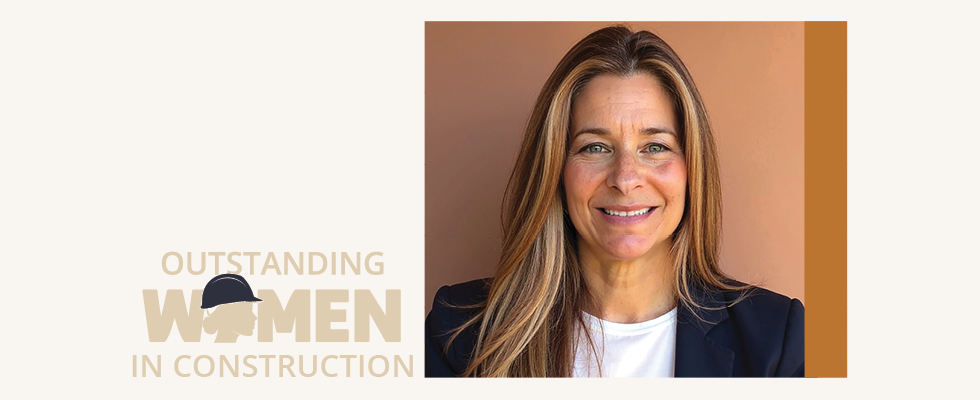
Christie Gloster, Trade School Director at Extollo Training & Construction S.A.
Outstanding Women in Construction 2026 finalist

Following the 2010 earthquake in Haiti, Christie Gloster saw firsthand how devastating “poor construction” could be. “In Port-au-Prince, structural failures turned a natural event into a human tragedy, claiming nearly a quarter of a million lives.”
That experience spurred her involvement with Extollo Training and Construction S.A. in Portland, Oregon, which eventually led to a position as trade school director.
Extollo International describes itself as a social enterprise that is “unleashing Haiti’s potential to build a stronger future by training a construction workforce of character and capability while adding strength and safety to Haiti’s infrastructure.” For the past 10 years, Extollo International has been developing and implementing a program that teaches Haitians how to care for themselves. Extollo combines classroom instruction with on-the-job training and supervision. Haiti has a need for skilled construction workers at the journeyman and contractor level, the organization notes, and it is meeting this need by teaching employable skills to the people in Haiti who need it the most: those living in extreme poverty.
It’s an organization to which Gloster has devoted 15 years of her life thus far, “helping to develop our vocational training center, which is raising building standards while equipping people with employable skills in a nation struggling with severe underemployment,” she said.
“Today, watching our students apply the fundamentals gained in our two-week intensive trainings and immediately begin to build safer, stronger structures keeps me excited about my work.”
Addressing specific projects, roles or pivotal moments that have been the most meaningful to her in her career, Gloster noted that from the start, Extollo Training and Construction’s ultimate goal in Haiti has been to empower local leadership to run its operations “so we could effectively work ourselves out of a job. Redesigning our curriculum and training a fully Haitian instruction team while maintaining the rigorous standards established by our U.S. staff has been a rewarding experience.”
Gloster added that in 2025, the organization opened a new campus in the north of Haiti. “To see it flourish has also been very satisfying.”
Gloster said her organization’s success has been built on partnerships with educational partners seeking to improve the lives of their beneficiaries through skills development “and with financial supporters who feel passionate about championing our cause. Partnerships are everything.”
Gloster would like to debunk the misconception that women simply aren’t cut out for the trades or lack the intrinsic ability to excel in them.
“Construction isn’t just about physical strength,” she said. “It’s about technical proficiency, creative problem-solving, attention to detail, analytical thinking and applied math. These are cognitive and practical abilities that are universally distributed regardless of gender.”
Regarding barriers she sees women still facing in the industry, Gloster noted that in Haiti — as is the case in many developing countries — women are more likely to work in the service sector in retail, trade or textiles. “However, nongovernmental organizations (NGOs) and international development organizations are making room for women in the trades by incentivizing contracted firms to recruit and train more women on construction sites,” she said. The Extollo Trade School also encourages and recognizes female students with the aim of closing the gender gap and creating an environment of inclusivity.
If Gloster could give her younger self one piece of advice about succeeding in the construction industry, it would be this: “It’s easy to let self-doubt set artificial limits on what you can accomplish. Looking back, the best advice I’d give my younger self is to stay open to new possibilities, trust yourself and place your faith in a purpose bigger than your own immediate plans. The most fulfilling paths are often the ones we don’t plan for.”
To foster the next generation of women in the workforce, Gloster noted: “We highlight the women who participate in our training programs, both as students and as trainers. We want to communicate through our programs that women can be top performers and leaders in this industry. When our students see a female lead instructor, this imparts a message about leadership and capability that speaks volumes.”
Gloster’s advice to industry leaders to better support and retain women in construction is that retention starts with culture, and culture is set at the top. “When executive leadership actively highlights, promotes and recognizes female achievement, it transforms the entire workplace dynamic,” she said. “It creates an inviting space for more women to enter and eventually choose to build a career in the trades.”
OUR DIGITAL PARTNERS