Why This Contractor Has Stayed Union 31 Years
How signatory status gives contractors reliable labor, safety culture & predictable costs on every project.
For the owners of Coastline Corporation, partnering with the International Union of Painters and Allied Trades (IUPAT) was never just a business decision; it became the foundation on which they run their business. With more than 31 years in the wallcovering business and being a signatory contractor dating back to the 1980s, Coastline Corporation has built a thriving operation serving the Philadelphia and Atlantic City markets. Their message to fellow contractors is straightforward: the IUPAT doesn’t just support your workforce, it supports your bottom line.
Across North America, signatory contractors in the painting and the finishing trades are discovering what Coastline Corporation has known for decades: a strong union partnership isn’t a constraint on business; it’s a competitive engine that solves one of the industry’s biggest challenges. When a large-scale project hits the market, clients don’t want to hear that you can’t find enough qualified workers. They want to know you can deliver, on time, on budget, and at scale.
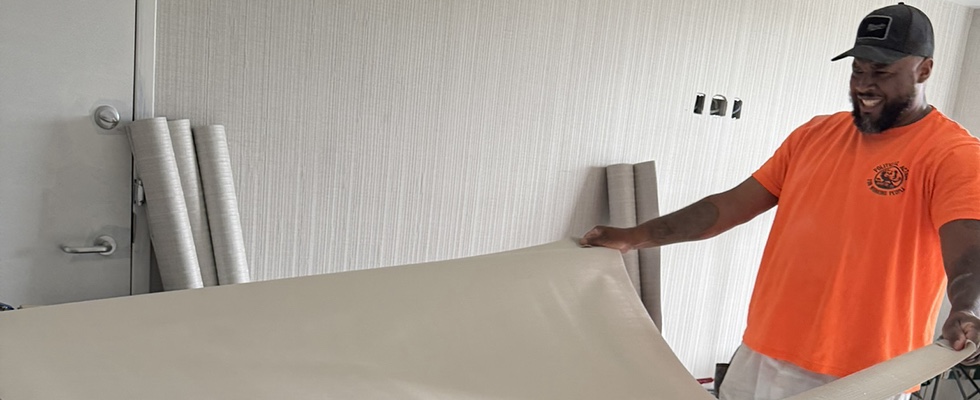
Through their IUPAT partnership, Coastline Corporation has direct access to a large number of qualified, pre-vetted workers ready to mobilize when opportunity knocks. That capability is what has allowed Coastline to take on a 1,500-room hotel renovation in the heart of Philadelphia, which is the kind of project that simply isn’t realistic for a non-union shop without the same labor infrastructure.
For signatory contractors, union membership offers this as one of its most tangible advantages: reliable access to a pool of skilled, job-ready workers. Rather than scrambling to post job listings, conduct interviews, and vet unknown workers under deadline pressure, union contractors can call for workers who have already been screened, trained, and dispatched through a system built specifically for the trades. The results are faster mobilization, fewer hiring mistakes, and the ability to say yes to projects that would otherwise be out of reach.
Your reputation is built project by project. One bad job, sloppy finishes, safety incidents, and rework can cause client relationships that took years to build to fail. Union members arrive on the job with documented training behind them: OSHA certifications, specialized skills, upgrade training, boot camps, wallcovering trade training, and more. For owners who stake their reputation on every project they deliver, that baseline of professionalism and safety culture isn’t a nice-to-have. It’s a competitive necessity.
The IUPAT’s Joint Apprenticeship and Training Committees (JATCs) run some of the most rigorous trade training programs in the industry. Apprentices go through multi-year programs that combine On-the-Job Learning (OJL) with Related Classroom Instruction (RI), ensuring that by the time they arrive at your job site, they know what they’re doing. For contractors, this means less time spent supervising and correcting and more time spent running a profitable business.
Safety is a huge and non-negotiable aspect of our union culture. Fewer accidents mean lower workers’ compensation costs, fewer project delays, and less exposure to liability. Over the long run, the indirect savings from a safety-conscious workforce can be substantial, a benefit that rarely shows up on a simple cost comparison between union and non-union labor, but one that experienced contractors understand well.
It is well known that tight margins and costly surprises go hand in hand, which is why one of the most underappreciated benefits of being a signatory contractor is the financial predictability that comes with collectively bargained wage agreements. Labor rates are locked in through multi-year agreements, meaning no guesswork for project bids, more accurate cost forecasting, and fewer unwelcome surprises. When you know exactly what your labor costs will be 18-24 months from now, you can bid jobs confidently, while protecting your margins, and avoiding the painful situation of winning a bid only to watch your profit evaporate when labor costs shift unexpectedly.
That stability is especially valuable on long-duration projects, where the gap between what you bid and what you pay can make or break profitability, and it’s a buffer that non-union contractors, subject to wage fluctuations driven by competition, economic conditions, and worker shortage, simply don’t have. High turnover compounds the problem further, with the costs of recruiting, onboarding, and training new workers multiplying across the workforce until the drag on productivity becomes significant. Coastline Corporation has largely avoided both pitfalls: IUPAT’s robust benefits package, including health insurance and pension plans, keeps workers loyal and engaged, with some of Coastline’s employees staying with the company for over 30 years.
There’s a simple reason for this: workers feel financially secure and value staying. IUPAT benefits aren’t just perks; they’re retention tools. Health coverage that workers can count on, retirement savings that build over time, and the professional identity that comes with belonging to a respected trade organization all contribute to a workforce that shows up, works hard, and stays. For contractors, this translates directly into a more experienced, cohesive crew. Workers who have been with you for years know your standards, your clients, and your culture. They require less supervision, make fewer mistakes, and take pride in the quality of their work. That institutional knowledge is genuinely hard to put a dollar value on, but any contractor who has lost a key employee knows what it costs.
What many contractors don’t realize until they experience it firsthand is that a union relationship is less like a vendor contract and more like a business partnership. The IUPAT has a vested interest in your success. When you win work, your employees work. When you grow, the IUPAT will grow with you. That alignment of interests shapes the relationship in ways that go beyond the formal agreement.
IUPAT union representatives understand your industry. When you are short-staffed on a critical phase of a project, IUPAT moves quickly to find you people. When disputes or challenges arise, there is an established process for resolving them. When safety or training concerns arise, the union has resources to help address them.
As Coastline Corporation has come to appreciate, having IUPAT as a leverage, and not something they work around. For Coastline, they have become a trusted advisor. Training programs become recruitment pipelines. The relationship deepens over time, and with it, the mutual benefits grow.
This is increasingly important as the construction industry faces a well-documented skill labor shortage. Owners and developers are looking for contractors who can credibly staff up large projects. General contractors are scrutinizing subcontractor capacity before awarding work. In that environment, being a signatory contractor with access to the union’s labor pool is a differentiator that directly affects who gets the job. Beyond the workforce, there’s also a reputation dimension. Many major commercial and institutional clients, such as hotel chains, hospitals, colleges, and public agencies, prefer or require union labor on their projects. Being a signatory contractor opens doors that are simply closed to non-union firms, regardless of price. The construction industry rewards contractors who build systems, not just buildings. The ones who grow sustainably over decades are usually those who figured out early how to attract good workers, keep them, and leverage relationships that give them a structural advantage over the competition. Coastline Corporation’s story is 31 years in business, with a workforce that includes decades of tenure, and the capacity to take on bigger projects. It’s a partnership that chose, invested, and built a strong, reliable business around.
For the construction business owner, evaluating their labor strategy shouldn’t be about asking whether a union partnership costs money. The real question is what it buys you: skilled workers, reliable labor supply, financial predictability, employee retention, safety culture, and access to work you couldn’t otherwise bid on.