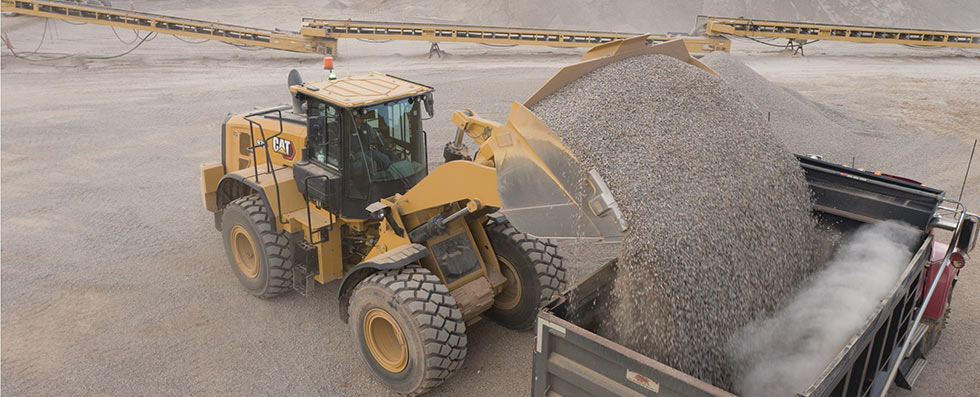
Your Manual for Effective Truck Loading
How to increase wheel loader efficiency
From operator technique to material density, multiple factors determine how efficiently a wheel loader loads trucks. However, two critical components — the trucks’ position relative to the loading face and how well the operator fills the bucket — significantly impact efficiency.
Why is it critical to maintain loader efficiency? Even minor losses in loader efficiency can be costly.
Consider a 3-cubic-yard loader loading material from a loose stockpile into 9-cubic-yard trucks. The operator should complete the cycle — filling the bucket, dumping it into the truck and returning to the face — in 30 seconds, fully loading the truck in three passes. Assuming 50 minutes of operation every hour, 133 truckloads should be moved in a morning.
Now, suppose cycle time increases by only 20%, adding six seconds to each pass. You move 111 truckloads in four hours, 22 fewer trucks, leaving nearly 200 cubic yards on the pile.
Conversely, if the operator reduces cycle time by just one second to 29 seconds, under the same circumstances, that operator will load five more trucks, moving an additional 45-cubic-yards of material than with a 30-second load cycle.
Filling a bucket to 100% of its rated capacity is key. If the operator can only manage 85% bucket fill, it will take more than three passes but less than four, impacting efficiency.
Match the Loader & Bucket
“Two places to start to boost efficiency are matching the loader to the trucks and the bucket to the material,” said Carter Gibbons, senior product demonstrator and instructor for Caterpillar. “For on-highway trucks, filling the truck in two to three loader passes is optimal.”
Many do a good job matching the loader to the trucks to get this pass-match, but selecting the right bucket is just as critical. Factor in the density of the material being loaded. “Clean highway chips weigh less than base material,” said Gibbons. “So, often, companies will average the weight of materials loaded to select a bucket.”
However, this can sacrifice production and efficiency for convenience. “Loader manufacturers are offering payload overload prevention technology that enables customers to use a large enough bucket to achieve target pass-match across a density range without introducing the risk of overload. When an overload value is exceeded, the lift arms will either slow or stop,” mentioned Gibbons.
Filling the Bucket
Start flat on the loading floor to fill the bucket and not from a couple of feet off the floor, as the lower third of the loader’s lifting range is where the machine is most efficient. Most loaders have a return-to-dig setting that enables the operator to set the lower hoist kickout to a preset height to where the bucket returns. When loading sized material from a stockpile, be careful not to drop the bucket to the ground too soon to avoid contamination of the stone with material off the loading floor.
Go into the pile with the bucket parallel to the floor, and as forward progress begins to slow, just before the tires begin to spin, boom up to transfer weight to the front tires. Keep hoisting while curling and, when curled back all the way, the bucket should be loaded.
The key is to keep the bucket moving through the face to keep filling it. Curling the bucket before booming up accelerates wear on the bucket’s heel. Alternatively, continuing to crowd the pile with the transmission serves only to rob hydraulic power, and the hydraulics begin to stall. “The bucket should be loaded by the time the loader arms are halfway through their range of travel, or about parallel to the ground,” said Gibbons.
.png)
Truck Spotting
The wheel loader operator plans the best way to bring in the trucks and work the material face, taking control of the loading area and spotting trucks for the best production. Hoist the filled bucket over the spot where you want the dump body, and have the truck driver back underneath the bucket to improve loading safety.
Spot trucks as close as possible to where the loader is working, at a 30-degree to 45-degree angle to the loading face. The loader should be able to approach the loading face squarely, back away from the loading face, change direction and drive forward to the dump box, arriving with less than a 5-degree angle in its articulation joint. Caterpillar recommends only about 1.5 revolutions of the loader’s wheels on each side of this tight V-shaped pattern.
Working from left to right, keep truck drivers on the same side of the truck as the loader to not back into the loading zone on their blind side. Open a space in the face against one end and then back the second truck, and all those following, into the hole created. “If there’s a conveyor building the stockpile, take care not to put the trucks in a position where material can slough off the pile onto them,” advised Eric Mayfield, senior product demonstrator and instructor for Caterpillar.
Truck placement can be more challenging on construction sites, since there might be material piles scattered about and due to the different types of trucks being loaded. Tractor-trailer combinations can be harder to back into position, so it’s better to pull trailers through between the face and the loader.
If the operator doesn’t have radio communication with the truck, they’ll have to rely on hand signals and horns. “If necessary, stop briefly and talk to truck drivers to get things set up at the face. The right planning will help make up that time,” added Mayfield.

Truck Loading
Never back up a wheel loader without looking behind first. Setting the boom-height kickout to hoist the bucket high enough to make the dump automates the boom function, so you can concentrate on backing and maneuvering the machine safely.
Camera technology has evolved significantly over the years to increase safety when operating in reverse. Many loaders will include cameras offering 360-degree views around the loader. Rear object detection uses radar to give the operator visual and audible alerts, based on loader speed, when those objects enter a safety proximity zone.
Operators must know how many buckets it takes to fill each truck being loaded and where to place those buckets. Center the load right to left and distribute it evenly from front to rear, especially on highway trucks, as the Department of Transportation closely watches axle splits.
Choose travel routes for load-and-carry operations carefully, preparing them to prevent spillage and carry the load as low as possible in transit. If equipped, the loader’s ride control helps improve smoothness and material retention over rough terrain.
Efficiency-Boosting Technology
Some newer loader models are equipped with technology that automates the most difficult segments of the loading process, improving efficiency for both new and experienced operators. The systems start the load cycle as soon as contact with the pile is detected. Tires are automatically set to help maintain traction, reduce tire spin and support consistently high bucket-fill factors.
Payload technology simplifies machine operation by offering precise bucket load information with on-the-go weighing to help prevent over- or underloading. “This technology also features manual or automatic tip-off assist to help optimize the final bucket process and maximize efficiency,” said Mayfield.
Coaching to Perfection
Consider options like on-board operator coaching videos that loader manufacturers are beginning to offer to improve machine operating techniques. These valuable systems monitor technique aspects — both basic elements and lesser-known best practices. When an improper machine operation technique is observed, a corrective action is offered.
OUR DIGITAL PARTNERS