Building a Great Safety Culture Takes a Commitment to Training
Select the right programs to best educate & protect your workers
Why is safety so important? The reasons are clear and fundamental: from staying alive to being there for family, and from avoid life-changing injuries to saving money, mitigating legal risk and gaining productivity. These are the basics of a good life for workers, and good business for construction companies.
Construction business leaders demonstrate their commitment to safety in many ways. One very visible way is by providing their workers with (or requiring their subs to have) consistent safety training. When workers are regularly and effectively trained on proper safety practices, they not only gain valuable new knowledge, but understand and appreciate that the company takes safety seriously.
This sponsored content is provided by both Construction Business Owner and Pure Safety Group, who may follow up with you regarding their products and/or services. Please complete the form below to continue reading.
How Workers Learn: Education & Training
A combination of education and training is the right mix for workers to learn what to do, how and why to do it, and begin changing their behavior toward making safer choices. Every worker has a right and a responsibility for helping to maintain a safe workplace and to work safely. Behavior-based education and training increases workers’ understanding of the consequences of their actions, or inactions, and that they play a key role in identifying hazards on the job and mitigating and managing risks.
Safety education focuses on learning theory and/or expanding established skills via systemic instruction.
Safety training teaches a worker particular skills and types of behaviors through practice and instruction over a certain period of time. Training typically provides for an increased rate of retention over education. During and after training, students must demonstrate understanding and show proficiency in practical applications and undergo a final knowledge assessment. The purpose of training is to improve the performance and productivity of employees.
The definition of training is the passing of information from one person to another. During training, especially the hands-on portion, students are inspired to take a specific action that can make all the difference in enhancing their safety. The added benefit of training is that is can extend far beyond the course, when one trained worker passes learnings on to more workers, and so on and so on.
Training Regulations & Standards for Fall Protection
The leading causes of private sector worker deaths (excluding highway collisions) in the construction industry were falls. According to the most recent data, in 2018, there were 338 fatal falls to a lower level in the United States, out of 1,008 construction fatalities, according to the Bureau of Labor Statistics (BLS).
The second leading cause of construction fatalities is being struck by an object. Increasingly, fall protection safety training includes training that teaches workers how to avoid dropping objects when working at heights. Objects falling from a worksite injure people below—both workers and nonworkers—and damage other equipment and structures.
The Occupational Safety and Health Administration (OSHA) requires employers to provide specific training that addresses these hazards for working at height, to employees who might be exposed to a fall hazard. The level of training must be relevant to the level needed by the employee receiving the training.
OSHA requires a variety of trainings with relation to fall protection. These include, but are not limited to: Fall Protection 1910.30(a)(1) and 1926.503(a)(1) which address fall protection awareness, and competent and authorized person training. Fall protection encompasses confined space and rescue; thus fall protection training also includes programs for those working in environments where there are risks for accidents in confined spaces that require rescue of workers who are involved. OSHA confined space training is 1910.146(g)(1) and 1926.1207(a), and its rescue standards are 1910.30(a)(1) and 1926.503(a)(1).
OSHA1926.503(a)(2) requires that the employer assures the employee is trained by a competent trainer. Some of the areas competent trainers must be qualified/proficient in include, but are not limited to:
- The nature of fall hazards in the work area
- Correct procedures for erecting, maintaining, disassembling and inspecting the fall protection systems to be used
- Use and operation of guardrail systems, personal fall arrest systems, safety net systems, warning line systems, safety monitoring systems, controlled access zones and other fall protections
- The role of each employee in safety monitoring systems
- Limitations on the use of mechanical equipment during the performance of roofing work on low-sloped roofs
- Correct procedures for the handling and storage of equipment and materials
- Erection of overhead protection
- The role of employees in fall protection plans
- Standards contained in this subpart
ANSI fall protection standards require much the same training as OSHA standards. Employers should train each employee who might be exposed to a fall hazard during the course of their work; the ANSI standard for fall protection is Z359.2 – 5.1 and its rescue standard is Z359.4 – 7.3.
Who Is Responsible for Fall Protection Training?
Employers are responsible for ensuring training happens for every employee who may be exposed to fall hazards. Not only do employers have this responsibility toward their employees, but for their business and the owner of the project they are building.
More construction owners need to take this responsibility seriously. OSHA’s fall protection training requirement 1926.503 was the eighth most-frequently cited agency standard in 2019, with enforcement citations totaling 1,955, inspections totaling 1,899 and proposed penalties of close to $3 million. Construction industry employers were the most cited for violations of the standard.
The employer verifies compliance with training requirements by maintaining a record of written certifications of employees. Retraining should happen when the employer has reason to believe that an employee who has already been trained no longer understands or has the skill required by the standard.
Beyond meeting OSHA requirements, employers can demonstrate to their employees that they maintain a proactive safety culture by:
- Training workers when it makes sense to improve their skills, even if a training standard is voluntary
- Ensuring the worker has uninterrupted time away from the job to fully concentrate on and immerse his/herself in the training program; this includes making sure his/her work is being done while the worker is away from the job
- Making technology accessible to workers when training or education is conducted online
- Supporting workers’ interest and requests for training or education, including online programs, webinars or podcasts
- Reserving time and space on-site at the worksite for training to come to the location, especially if more workers can be trained and/or if the training program you’re interested in has a facility too far from the region where your projects are
- Allowing workers who have been newly trained to come back to the worksite and share their knowledge
- Celebrating and recognizing workers for new certifications and recertifications, and appreciating their passion for enhanced knowledge, performance and productivity
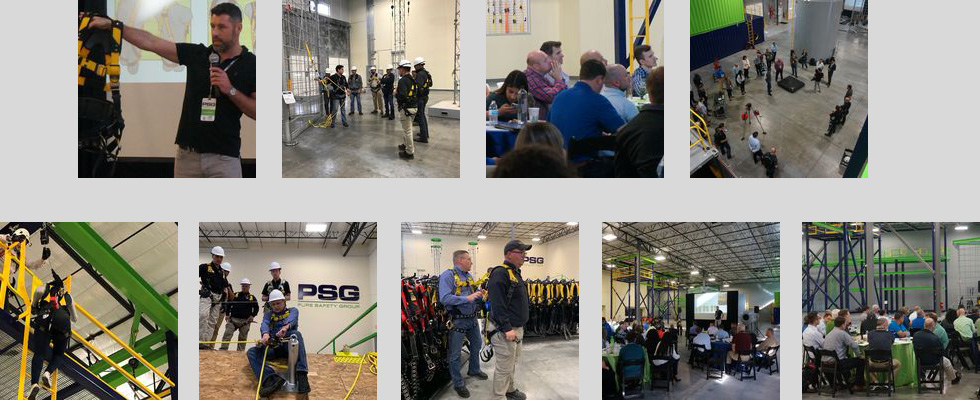
- Selecting training programs that have apparatus and structures that simulate real-life work-at-height scenarios
- Choosing training programs that are professional, proven and recommended by other respected construction business owners
How Often Is Training Required?
OSHA does not give definitive frequencies of retraining. However, Height and Rescue Training (HART) by Pure Safety Group (PSG) utilizes the ANSI recommended 2-year timeframe. Other training providers vary as to the frequency at which they suggest refresher/recertification training.
There are other occurrences in which retraining is required (1926.503(c)(1-3) and 1910.30(c)(1-3)), regardless of timeframe. These include:
- When changes in the type of fall protection systems or equipment to be used render previous training obsolete
- When changes to the workplace render previous training obsolete
- When inadequacies in an affected employee’s knowledge or use of fall protection systems or equipment indicate that the employee has not retained the requisite understanding or skill of how to apply proper, effective fall protection processes on the job
What Types of Fall Protection Training Exist?
PSG, through its HART training programs, provided at three PSG locations (Washington state, Texas and the U.K.), online and on-site at the worksite, offers a variety of courses for a broad range of trades and industries. HART training includes lectures, demonstrations, hands-on learning and assessments to determine students’ proficiency. By making training simplistic, interesting and interactive, students are able to retain much more information than without this proven mix of learning applications.
HART training instructors have workplace safety backgrounds; chances are they worked in the same situations as the students, which enables a deeper dive into the specific information workers need to return to their worksites with relevant, enhanced approaches to safety. HART instructors teach courses that address:
- Fall Protection Awareness
- Authorized Person Training, Certification and Recertification
- Competent Person Training, Certification and Recertification
- EM385 Competent Person- USACE
- Train-The-Trainer (TTT)
- Authorized Rescuer Training, Certification and Recertification
- Competent Equipment Inspector Training, Certification and Recertification
- Confined Space Awareness
- Confined Space Non-Entry and Entry Rescue
A culture of safety that includes proper fall protection training saves lives, reduces costs, improves productivity and leads to successful projects and companies. Construction business owners do well by their employees, their businesses and their customers when training is a key component of their culture, focused on running their operations safely.
For more information, including a training course schedule, visit https://www.puresafetygroup.com/hart-training or contact Arissa Mendiola at 1-800-466-6385 ext. 103 or [email protected].

About PSG
Pure Safety Group (PSG) is the largest independent dedicated fall protection company in the world, providing high-performance and professional fall protection equipment, tool tethering products, and services such as engineering and onsite consultation. HART Training by PSG offers comprehensive, hands-on training at three training facilities, on-site at the worksite and online to companies in the construction, oil and gas, energy, utilities, telecom, mining and transportation industries. PSG was formed by a team of industry veterans with a family of companies and brands including industry-leading fall protection companies Guardian Fall Protection, Checkmate and Stronghold by PSG.